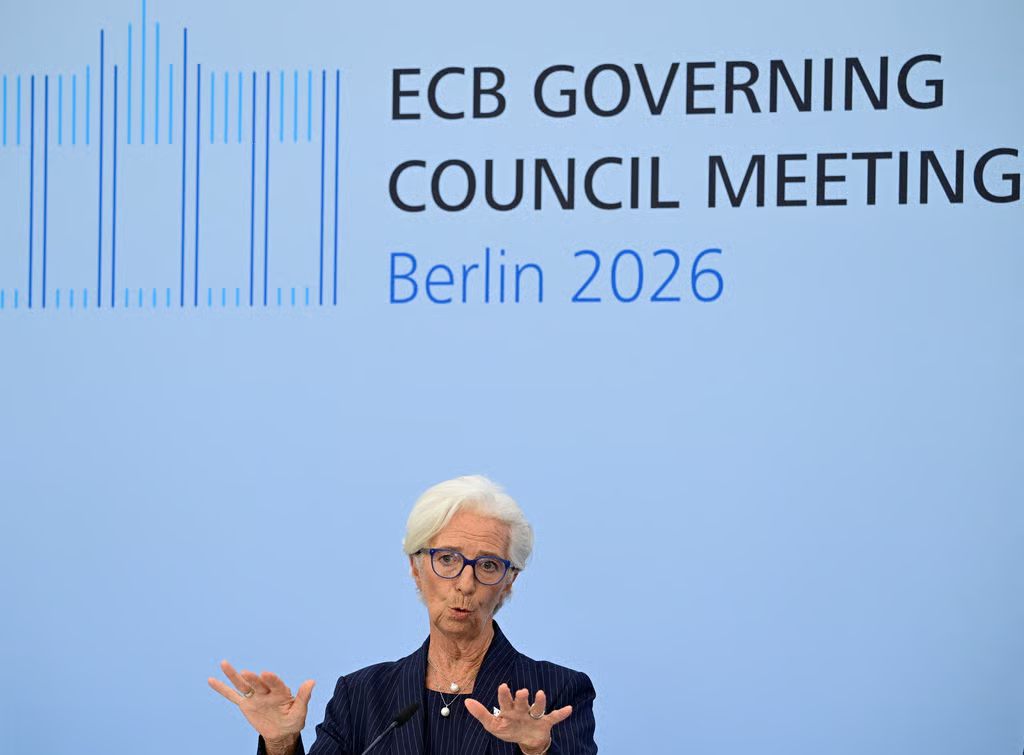
Whoever takes on top roles at the ECB will face huge challenges as the fallout of the Iran war continues to hit Europe’s economies.
AI generated Text-to-speech
FRANKFURT — The European Central Bank faces a pivotal week with storm clouds gathering on two fronts: French market turmoil and uncertainty over the Frankfurt institution's top jobs.
Rate-setters will gather on Wednesday and Thursday to, as is widely expected, hold the central bank rate at 2.5%. After last month's meeting, investors predicted even odds of a hike this month, but France's deteriorating outlook has reshaped the debate.
Paris faces some of the worst market conditions in two decades, with violent protests adding to investor concerns about political instability and the government’s ability to rein in its deficit. Last week, French 10-year bond yields reached their highest level since 2002, while the premium over similar German bonds reached a 15-year peak, underscoring investor unease about France’s fiscal outlook.
At the same time, uncertainty over who will take the helm at the Frankfurt-based central bank is set to linger, after a deadline for governments to nominate a successor to executive board member Isabel Schnabel slipped to Nov. 27, according to two people familiar with the matter. The original cut-off date for names was this Wednesday.
Christine Lagarde's future also remains uncertain as rumors continue that she will end her October 2027 term early.
Schnabel's replacement is a key decision which will help determine who is at the policy table as the Bank navigates the next market squall. The delay in naming her successor increases the likelihood that governments will engage in horse-trading to place their favored candidates in the multiple roles that are soon becoming available, including Lagarde's.
Whoever takes on those roles will face huge challenges as the fallout of the Iran war continues to hit Europe's economies.
The ECB's upcoming rates decision on Thursday comes amid continued economic deterioration as price pressures show no signs of abating. Oil prices are significantly higher than assumed in the ECB’s September projections, adding to the risk that inflation will overshoot, with oil reaching a five-month high of $114 on Friday.
“This suggests upside risks to its inflation forecasts,” Bank J. Safra Sarasin Chief Economist Karsten Junius said. “We would agree that another rate hike is appropriate but not urgent as higher government bond yields and wider spreads for riskier credit segments have already tightened financing conditions,” he added.
ING Head of Macro Carsten Brzeski estimates the rise in German yields has had an effect similar to a 25-basis-point rate hike, and in France, closer to 50 basis points. “The bond market has taken over the ECB’s job,” easing pressure for a move this month, he argued.
The recent rise in French borrowing costs has fuelled speculation over possible ECB interventions via its as-yet unused Transmission Protection Instrument, or TPI, which allows it to buy government bonds should unwarranted, disorderly market pressure threaten policy transmission.
While higher borrowing costs may slam the brakes on the ECB tightening course, analysts say Lagarde will likely make clear on Thursday that the bar for using the tool to bring down French borrowing costs remains high.
“Any intervention via the Transmission Protection Instrument (TPI) remains very unlikely, given France’s failure to fully comply with the euro area fiscal framework,” Junius said.
For now, the market moves remain below those at which the ECB previously intervened. But if spreads widen further, the Bank could face growing pressure to act. Brookings Institution Senior Fellow Robin Brooks wrote in a blog: “Once we reach 250 bps [basis points] the ECB will step in, just like it's done every time in the past.”
The activation of the TPI hinges on a slew of criteria including broad compliance with the eurozone’s fiscal framework, but the ECB has left itself some discretion, saying that the intervention criteria “will be dynamically adjusted to the unfolding risks and conditions to be addressed.” German critics have long worried that such flexibility could allow the ECB to support countries that fail to follow fiscal rules, weakening governments’ incentives to make difficult spending cuts.
All of this makes the ECB board nominations more than just a routine operation.
Schnabel, who oversees the ECB’s market-operations portfolio, is due to leave in early January. Philip Lane’s chief economist post will become vacant at the end of May. A recent Reuters report suggested that rumors about Lagarde’s early exit may finally end next week, when she might be elected chair of the World Economic Forum.
The leading contenders to succeed Christine Lagarde, who will leave at the latest when her term expires in October 2027 next year, are the Netherlands' former central bank chief, Klaas Knot, and Pablo Hernández de Cos, the Spanish head of the Bank for International Settlements.
For months, France and Germany were seen as rivals for the powerful chief economist post. Yet the recognition of the importance of the market’s portfolio has been on the rise and in today’s environment possibly a preferable role for Germany. Peter Praet, a former chief economist at the ECB, believes the role of markets operation chief could be “just as important” as the chief economist.
The post Berlin fights to retain — and the candidate it backs— could offer early clues on who and how the ECB will lead Europe through the next wave of economic turmoil.
Pablo Hernández de Cos and Klaas Knot bring long records in monetary policy — and sharply different memories of the Draghi years.
In a video to staff, seen by POLITICO, the outgoing ECB president says her coverings are due to “a little skin cancer that had to go.”
The ECB chief is set to wade back into French politics as her centrist rivals fail to stop the momentum of left- and right-wing populists.
As climate risks mount, the ECB faces a test of its commitment to green finance.