External advisers have delivered their assessment of the EU executive’s future — but major restructuring decisions are still some way off.
AI generated Text-to-speech
BRUSSELS — Ursula von der Leyen’s push for a sweeping overhaul of the European Commission moved closer to fruition on Monday, as a group of external advisers handed over a report that will help shape the institution’s biggest administrative shake-up in two decades.
The report, drawn up by a high-level group led by former Commission Secretary-General Catherine Day, marks a new stage in the so-called large-scale review — an exercise intended to make the Commission more efficient, streamline its sprawling bureaucracy and turn it into a more attractive employer.
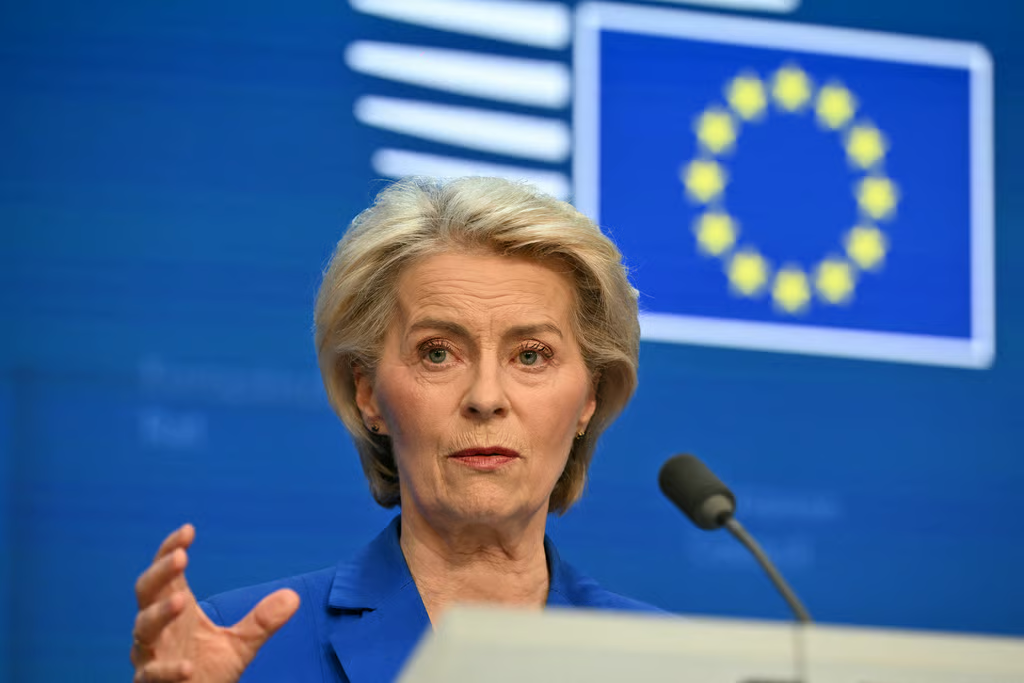
“Now we’re reaching the second phase,” von der Leyen said at the handover, referring to the conclusion of an initial phase that involved 15 internal workstreams and contributions from thousands of Commission staff.
“We need to be able to act effectively and to act quickly,” she said about the needed changes in the EU Executive’s machinery. “That means simpler procedures, clearer structures, better cooperation across departments so that our colleagues can focus their efforts where it makes the greatest difference.”
The external group, consisting of Day and eight other experts with experience in national administrations and international organizations including the OECD and OSCE, put forward nine interrelated recommendations aimed at making the Commission more agile and better equipped to adapt to future challenges.
Among its main proposals is a shift away from working in siloed departments toward greater collaboration across directorates-general, including through cross-DG portfolios.
This part of the exercise is politically sensitive. Behind the push to modernize the Commission lies the prospect of a far-reaching reorganization of its departments, potentially redrawing the responsibilities of powerful directorates-general that oversee billions of euros in EU spending.
As POLITICO first reported, several major Commission departments face an uncertain future under plans to overhaul how the bloc manages and distributes EU funds, raising the prospect of mergers or other structural changes.
Among the departments potentially affected is the Directorate-General for Regional and Urban Policy (DG REGIO), which oversees cohesion policy funding, accounting for almost a third of EU spending. Other departments facing uncertainty include the Directorate-General for Agriculture and Rural Development (DG AGRI), responsible for Common Agricultural Policy money; DG EMPL, which oversees employment and social funding; DG MARE, which handles fisheries funding; and DG RTD, responsible for research and innovation.
The group also called for a stronger Secretariat-General to act as a strategic center driving results, and for a human-centered approach to artificial intelligence to simplify administrative processes and modernize the institution’s operations.
But the release of the report on Monday does not mean that any restructuring decisions have been taken. Day’s report will feed into a wider review overseen by Budget and Public Administration Commissioner Piotr Serafin, who is tasked with presenting final recommendations to von der Leyen by the end of 2026.
Serafin said at the handover that the external assessment, combined with feedback from Commission staff, provided a “mandate to go for far reaching changes.”
Day, for her part, said the Commission had already demonstrated a willingness to reform, pointing to the wealth of ideas emerging from within the institution.
“The work done on the large scale review has shown that there is a broad coalition for change right across the Commission,” she added.
A separate internal process produced an initial set of recommendations in July, drawn up by Commission officials. Those proposals were intended to kick-start a broader discussion within the institution rather than serve as final decisions.
Any major reshuffling of the Commission’s structure, however, is likely to take considerably longer.
Speaking in July to a small group of journalists, including POLITICO, Serafin acknowledged that structural reforms would be closely tied to negotiations on the EU’s next long-term budget, known as the Multiannual Financial Framework, which will determine how EU spending is organized from 2028 to 2034.
He indicated at the time that he did not expect decisions on major structural changes before those budget negotiations are concluded.
For now, Day’s findings will provide another input into Serafin’s final proposals, bringing von der Leyen one step closer to deciding how far she wants to go in reshaping the institution she leads.
Brussels also wants the agency to be ready to respond to border crises within 24 hours, drawing lessons from Ceuta.
As Brussels works on closer ties with both countries, it is also looking for partners to help meet Kyiv’s rising costs.
Hosting EU leaders in Rome would give Italian Prime Minister Giorgia Meloni a high-profile international stage in an election year.
Zagreb is pressing Podgorica to resolve long-standing disputes over war crimes, compensation and border demarcation before wrapping up EU accession talks.