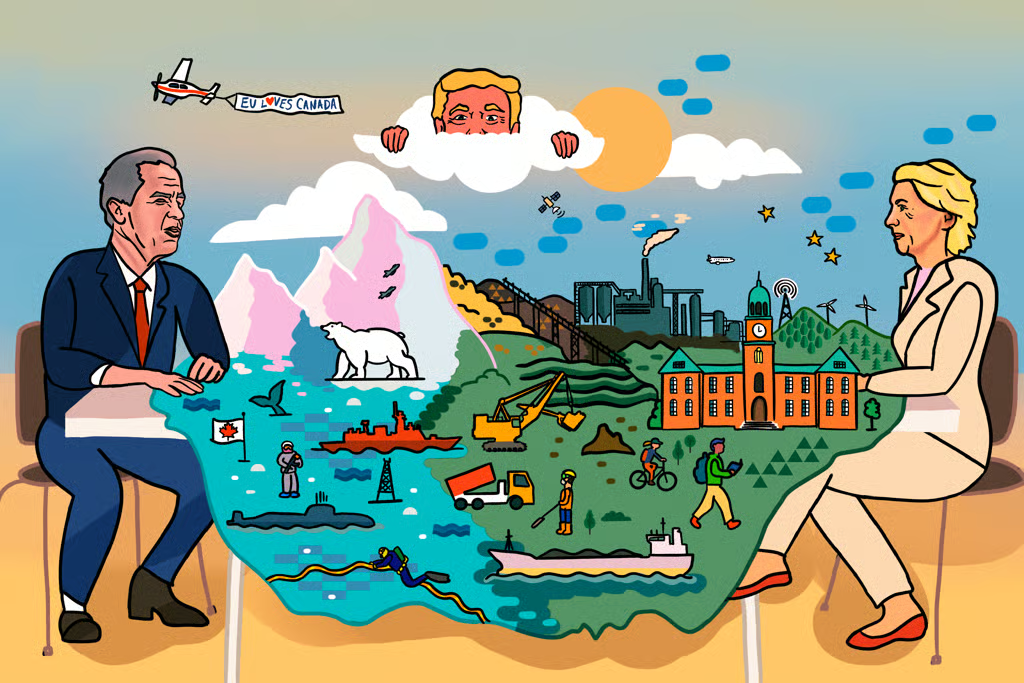
From defense to critical raw materials, a new wave of EU-Canada agreements is on the horizon.
By MAX GRIERA, CAMILLE GIJS, GABRIEL GAVIN and GERARDO FORTUNA in Brussels
Illustration by Natália Delgado/POLITICO
AI generated Text-to-speech
The EU is looking to pull Canada closer into its economic and security orbit as Donald Trump’s trade war forces Ottawa to seek allies beyond the U.S.
The offer under discussion spans critical minerals, digital trade, education, skilled workers and Arctic security. With Canadian Prime Minister Mark Carney due to address the European Parliament this week and an EU-Canada summit set for October in Montreal, EU officials are weighing what Ursula von der Leyen can concretely offer in her State of the Union speech on Wednesday.
The aim is to deepen cooperation wherever it benefits both sides — and give Carney a way to show Canadians that Ottawa has powerful friends beyond Washington, 15 officials, politicians and diplomats told POLITICO.
The most ambitious proposals would bring Canada closer to the EU’s single market, expanding its existing trade ties with the bloc and moving it toward the level of integration enjoyed by nations such as Switzerland and Norway.
Spanish Socialist lawmaker Javier Moreno, who chairs the Parliament’s delegation to Canada, called for the EU to integrate the country “even further” than Switzerland into its market. That could include giving Canadian citizens the freedom to live and work across the 27-country bloc and Canadian businesses smoother access to its 450 million consumers. Such an arrangement would be unprecedented for a country so geographically distant.
“Canadians are the most European people outside of Europe,” he said.
The push for closer ties comes after the U.S. banned imports of key Canadian manufacturing and agricultural goods, as the North American neighbors spiraled into a trade war with reciprocal tariffs after the collapse of negotiations last month.
“You don’t want to cause disappointment before the summit,” said an EU diplomat, referring to the October meeting, adding that von der Leyen should offer something tangible to Carney on Wednesday. They were granted anonymity to speak about the proposals under discussion, like others in this article.
That Carney will be seated in the chamber to hear von der Leyen’s address carries symbolic weight and “is already an important signal of the closeness of the relationship,” Geneviève Tuts, the EU’s ambassador to Canada, told POLITICO.
The Canadian prime minister has instructed his special envoy to Europe, John Hannaford, to scope out the most ambitious possibilities short of full membership in the bloc or its single market, one official confirmed.
The EU has a growing appetite for critical raw materials — used in everything from batteries and solar panels to mobile phones. Canada has abundant reserves of copper, molybdenum, aluminum, nickel, lithium, cobalt and rare earth elements, as well as the mines, smelters and refineries capable of processing them.
“Canada is of course the huge source of critical minerals,” EU Trade Commissioner Maroš Šefčovič told POLITICO. “Can we work on common projects? Can we gather enough investment and funding for some of these projects?”
That is a position shared by the lawmakers Carney will address next week. Valérie Hayer, a French MEP and chair of the centrist Renew group, said that “as Canada and Europe both look to diversify, this is the moment to intensify mutual trade. This requires fresh thinking and joint investment in infrastructure.”
One relatively straightforward step would be to bring Canada further into Erasmus+, the EU’s flagship education and training program, which is already open to countries including Iceland, the U.K. and Norway.
Nela Riehl, chair of the Parliament’s Culture Committee, told POLITICO she expects von der Leyen to fully integrate Canada into the scheme. Student exchanges already exist, but “there’s even room for more” because it would carry political weight, she said.
Expanding Canada’s participation in the Erasmus+ program is on the table, a Commission official said.
Riehl pointed to opportunities in sports, youth programs, vocational training and education. Beyond Erasmus+, she said, artist visas should be made easier for touring performers to foster cultural exchange.
A recent agreement on the mutual recognition of qualifications for architects should also be extended to professionals from all sectors, Moreno said. An existing scheme for skilled workers to come to the EU should be promoted in Canada, he added. Both steps would improve the movement of workers and expertise.
During her speech, von der Leyen could push EU countries to finally ratify the EU-Canada free trade agreement, or CETA, which was signed in 2016 but is still awaiting approval from 10 capitals.
Canadian companies could also gain privileged access to EU public procurement under the bloc’s proposed Industrial Accelerator Act, which seeks to favor European companies in the public procurement of green and energy-intensive industries.
“We want to do something more than a strategic policy that we have,” Tuts said, referring to CETA and the security-focused Strategic Partnership Agreement, signed at the same time. “That’s something we would like to reflect on and to build.”
Šefčovič expects the EU and Canada to conclude a digital trade agreement by the end of this year, covering online businesses and other parts of the internet economy.
“With Canada we also had very, very intense interaction on all levels because of course, personal chemistry among the leaders is excellent,” the trade commissioner said. “Canadian prime ministers know the Europe and the EU better than probably any other leader in the world.”
Moreno was more ambitious, calling for the digital trade agreement to be ready by the planned summit in late October.
Defense, security and the Arctic are also emerging as areas for closer cooperation, according to two diplomats working on the proposals.
Canada already has access to the EU’s flagship €150 billion defense funding scheme, SAFE, under an agreement finalized this year. Brussels is also rewriting its Arctic Strategy to address emerging hybrid threats, including subsea cable sabotage, new trade routes and physical connectivity.
Ottawa could gain a central role in those plans and, where possible, access to the EU schemes designed to support them, the diplomats said.
The issue carries particular weight for Ottawa, another EU official said. “The Arctic is our neighborhood, but it’s their main area.”
Moreno called for a comprehensive joint Arctic “partnership” covering natural resources and security — and for the EU and Canada to “explain to Trump that the Arctic is not his.”
Camille Gijs and Seb Starcevic contributed reporting from Brussels, Mike Blanchfield contributed reporting from Ottawa.