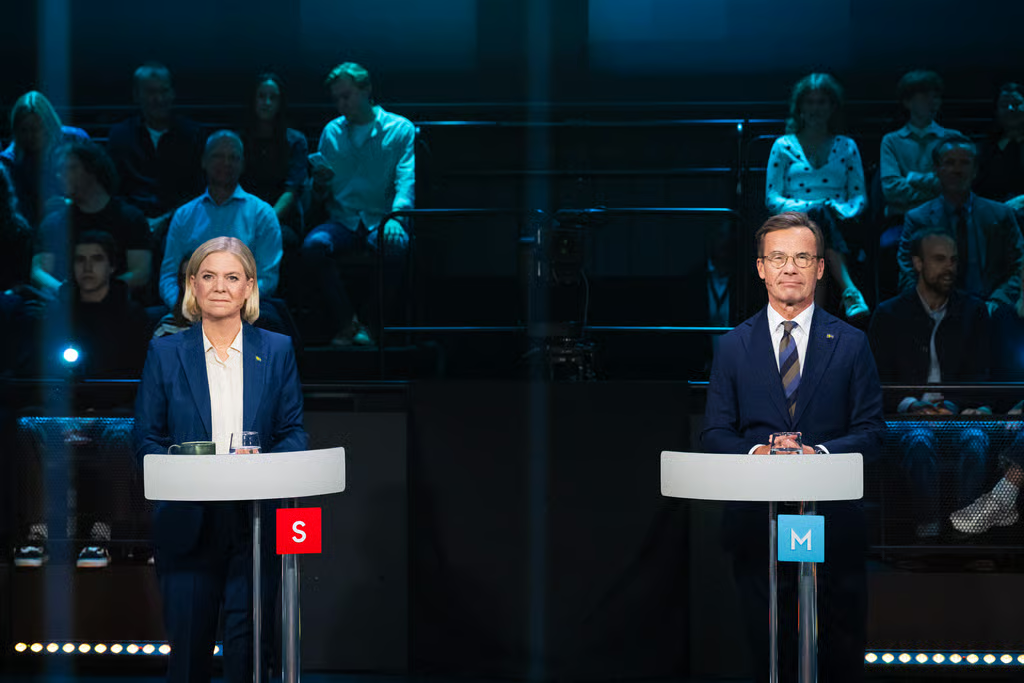
With most results in, the opposition left bloc leads by a single seat over an alliance that includes the far-right Sweden Democrats.
AI generated Text-to-speech
STOCKHOLM — Sweden’s high-stakes general election is heading toward a knife-edge finish that could yet hand power to the far right, according to official forecasts.
With most results now declared, the left-wing bloc of Social Democrat opposition leader Magdalena Andersson has a one-seat lead over conservative Prime Minister Ulf Kristersson’s four-party right-wing alliance. The final outcome of Sunday’s vote may not be known until Wednesday.
For months, Andersson’s left-wing bloc had been leading comfortably in the polls, but the race tightened dramatically in the last two weeks of the campaign.
Speaking after midnight on Monday, she said the results so far pointed to an “even” outcome. “But right now we are leading and if this holds up, Sweden will get a new government,” she said, to cheers from thousands of supporters gathered at her party’s glitzy election night reception.
The vote is a watershed moment for Sweden and will be watched closely elsewhere in Europe, where other nationalist parties are gaining ground.
If he continues in office, Kristersson has promised to give ministerial posts to members of the populist nationalist Sweden Democrats, a strongly anti-immigration party founded in the 1980s by neo-Nazis. That would be a first in a country that had until recently shunned the far right.
Kristersson has been governing for the past four years with support from the Sweden Democrats in parliament, but without giving them a formal role in the coalition.
He said the closeness of the result would make forming a government “complicated,” but insisted the left had failed to win a majority for its “socialist” economic program.
Kristersson added he would talk to other party leaders. “Where it ends remains to be seen,” he told his supporters at the Moderates’ election night party in central Stockholm. “But we are not in a hurry.”
Initially it seemed that Kristersson’s offer to the far-right Sweden Democrats had backfired. Two exit polls published when voting ended at 8 p.m. local time on Sunday gave Andersson’s bloc a clear lead.
But a few hours later, with more than 5,800 out of 6,600 districts declared, the Swedish Election Authority published projections that showed Kristersson’s alliance winning 174 seats in the 349-seat parliament — compared with the left bloc’s 175 seats.
For Andersson, who previously served as PM until 2022, such a close result would be bittersweet. After being ejected from power four years ago, she had been seen as a virtual lock to regain office. But her side’s double-digit poll lead evaporated amid criticism that her party’s campaign lacked verve; now she must wait to learn whether she will get a crack at forming a new government.
Andersson’s push to retake power received a celebrity endorsement on Sunday morning from ABBA’s Benny Andersson, who took the stage at the Social Democrat headquarters to serenade her. As he played the opening chords of “Mamma Mia,” Social Democrat staffers took up the refrain, replacing the chorus line with “Magdalena.”
“Swedish elections are always close,” Andersson told POLITICO earlier on Sunday as she toured the suburbs of Stockholm in her campaign bus. “When I’ve been around Sweden, a lot of people I’ve spoken to said they see things that the government has done that they like but there are also lots of things that they don’t like. And many people say to me that it’s enough now.”
Andersson accepts that a victory for her left-wing bloc won’t consign the Sweden Democrats to history, especially if the final margin is a narrow one.
“The hate that they have spread through this election, and if they would become ministers and use their platforms as ministers to spread hate? Well, we’ll see if the Swedish people are very tempted on that,” she said.
Kristersson insists that the Sweden Democrats can be trusted, having worked with them and their controversial leader Jimmie Åkesson to drive through hardline policies on immigration and violent crime.
The prime minister told POLITICO on Friday that potential ministers from the Sweden Democrats would have limited room to go rogue — because he would remain in charge.
“Since I will be the person that is forming that government, and the person that will appoint every one of them, I can guarantee you that it will only be very skilled and experienced and people with good judgment that would be part of my government,” he said.
In the coalition-building efforts that determine who gets to run the country, Sweden’s smaller parties often have outsized influence. That will be true again this time if the projections of a razor-thin victory margin are borne out.
On the right, Kristersson leads a settled alliance of four parties, including the Sweden Democrats.
Andersson’s path to a coalition, meanwhile, is potentially complicated by disagreements among the smaller parties in her bloc. Much may depend on her political skills and her ability to force through a power-sharing deal in the days and weeks ahead.
This article was updated on Sept. 14 to include reactions to the latest vote count.
With most results in, the opposition left bloc leads by just three seats over an alliance that includes the far-right Sweden Democrats.
Social Democrat leader Magdalena Andersson is heading for a comeback as prime minister in charge of a left-wing coalition, exit polling suggests.
Latest polls put Sunday’s vote in NATO’s newest member on a knife-edge.
The center-right leader told POLITICO that Magdalena Andersson’s political partners can’t be trusted on defense.